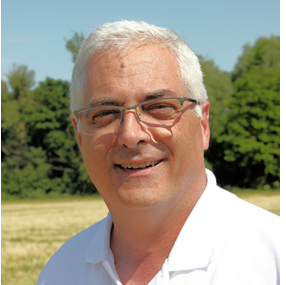
Giving us some insight into the intricacies of brewing fine beer, RCFC member Gary Hanning, retired Director of Global Barley Research for Anheuser-Busch InBev, told us about his career in the beer industry for our in-person meeting on January 24. After earning a bachelor’s degree in crop management, he spent a short time “back on the farm” before returning to school (University of Tennessee, Knoxville) for a PhD in plant breeding and genetics, concentrating on tissue culture as a source for improved crops. After post-docs at U. Nebraska (Lincoln) and CSU continuing to work on tissue culture, he moved to Anheuser-Busch working on R&D, corporate brewing, and barley research from 1989 until retirement in January, 2020.
During his time at Anheuser-Busch, the company grew dramatically, commonly by acquisition of foreign brewers, ultimately producing close to 100 million barrels of beer (32 gallons per barrel) in 2010, and commanding some 32% of global market share (about 1 barrel in 2 in the US, 1 in 3 globally). To compare with our local beer culture, Garry pointed out that the craft beer segment in the US produces around 25 million barrels or around 12% of market share.
So what is in beer and how does barley research fit in? Beer includes malt (generally barley malt), water (high-quality water is essential), yeast, and hops and perhaps including other adjunct grains (to provide starch) and flavorings (especially for heavier beers). There are actually two types of barley, 6-row and 2-row. Most beer is now made from the 2-row type. The process of combining these ingredients and getting a beer in your hand is now handled, at least in Anheuser-Busch, within a vertically integrated system that allows the company to understand the supplier’s business, spread innovation throughout the system, and control both costs and quality. On the consumable side, this involves integration of barley research, barley elevators, malt houses, rice mills, and hop farms. On the hardware side, this involves all of the aspects of creating bottles and cans. The goal is to provide a uniform, high-quality product.
Malting the barley involves steeping the grain (bringing water content to 12% to 45%), germination (for beer, the barley must be germinated with a target of at least 96% germination), and kilning (drying out the water and to add color & flavor). Brewing includes mashing (extracting enzymes and balancing other organic contents), filtration, and fermentation.
The breeding process (the focus of Gary’s career) takes around 15 years to produce a product that will be widely used. This starts with making around 1000 crosses to optimize population genetics, taking up to 4 years. These crosses are grown in hundreds of test plots of a few tens of square yards which are sampled several times per year. The samples are micro-malted and tested for some 15 malt-quality parameters. The best are then subjected to additional malting and brewing trials and, ultimately, government registration trials. Part of the driver behind this research is to continually improve the quality of the final product, but much of the driver is that Anheuser-Busch InBev (which acquired SAB Miller in 2016, in the process divesting Miller) continues to acquire brewers in other countries and the barley must be optimized for use in areas with different soils and climate. At its peak, barley research was being conducted in some 15 countries with a staff of 70 people located in 10 countries. In each new country, it was necessary to understand the brewing needs of the country, the local agriculture, the abilities of the staff and their associated budgets and organizational structure, the logistics of grain shipments, and the local registration processes for new varieties.
An off-the-wall example of the various challenges involved was a requirement to do research for “Bud on Mars”, which required trials in space looking at the biology of plants in zero gravity.
Question:
Can you tell us something about the process of scaling up from the test plots to widespread use? Basically, they have to look years ahead of anticipated need. They like to work in Arizona where the winters allow them to get two crops per year. Once the variety is approved for use, they can expand their seed stock by around 1% per year. With that growth, they can then expand to other states/nations.