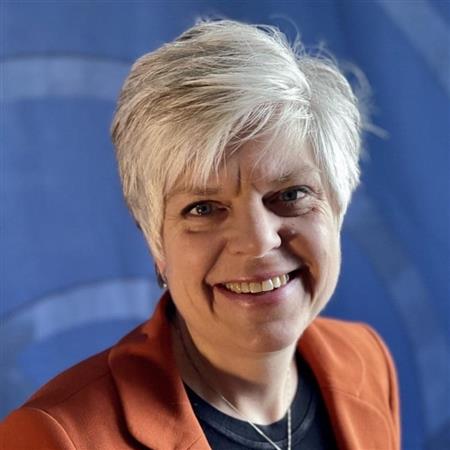
All the way from Lead, South Dakota, Deb Wolf, Director of Outreach & Culture for the Sanford Underground Research Facility (SURF), on July 26 gave us a presentation on “Sanford Underground Research Facility: Leading Innovation in Science and Education.” Ms. Wolf has been a teacher (some 30 years as a K-12 educator before starting her current job), not a physicist or engineer, and her current job is to translate for the public the importance of neutrinos, dark matter, and other advanced science matter in understanding our universe and how the science impacts education.
First, some data on the Homestake Mine, the former mine in which the research is being done. Ultimately the largest gold mine in the Western Hemisphere, Homestake was in Lead for 125 years, resulting in some 370 miles of drifts (the horizontal passageways that many might think of as tunnels) as well as several vertical shafts for access to the drifts. Although the mine extends down to more than 8,000 feet below the surface, the current science efforts are clustered at the 4850-foot level, which is still above sea level. At the time that the mine was abandoned and donated to the State of South Dakota (no additional mining is allowed at the site), the mine had naturally filled with water about the 4550-foot level. One of their significant ongoing expenses is pumping and processing water to keep the current water level well below the 4850-foot level. Access to the science levels of the mine is still through the Yates and Ross shafts, with workers descending in a “cage” some six feet wide by 12 feet long (looking vaguely like a large, industrial elevator). Equipment and supplies travel separately, either in the cage or suspended below it. Travel time to the science level is some ten minutes. There are some 200 workers per day who come to the site, several of whom are physicists; the rest are providing support for various levels of service.
Why is this science being done underground? It is not because it is secret. The most important reason is that nearly a mile of rock provides excellent shielding from cosmic rays (at the surface, your body is hit by one cosmic ray each second) and other cosmological background noise. In a cosmological sense, going deep underground is ten million times quieter than the surface. Although most of the science deals with high-energy physics (looking for dark matter – the LUX-ZEPLIN (LZ) experiment – and neutrinos – the LBNF/DUNE experiment), there is also research in biology (extreme life and astrobiology in areas with high temperatures and unusual chemistries), geology (geochemical energy and seismic studies), and engineering.
Currently, SURF does not give public tours as there is a great deal of construction underground for the new neutrino experiment. However, visitors can learn more at the SURF Visitor Center in Lead. Also, there is nothing dangerous about the experiments but one of their most important operational focus areas is safety.
The largest experiments, either ongoing or currently being built, are attempts to detect dark matter (which provides some 80% of the gravity that holds galaxies together but has essentially no other interaction with conventional matter) and to study neutrinos (which come in three “flavors” (1000 trillion neutrinos pass through your body every second without affecting you). The dark-matter detector uses xenon (several million dollars’ worth; so much that it upset the global xenon market), ultra-pure water, and a large bank of detectors to amplify the signal from the vanishingly small number of interactions they expect to see.
The neutrino detector, currently under construction, is designed to study neutrinos that will pass through the earth from the Fermi National Accelerator Laboratory (Fermilab) near Chicago (800 miles away). This experiment, the largest in the world, involves a collaboration between some 1500 researchers from 37 nations and more than 200 institutions. Much of the financing has come from the Department of Energy Office of Science with contributions from other countries. Ultimately three caverns will be excavated, each more than 500 feet long and 65 feet wide. Two of the caverns will be 95 feet tall. All of the equipment for both for excavation and data collection must be brought down to the 4850-foot level in or under the cage, so much of the larger pieces must be disassembled at the surface and re-constructed underground. The rock from the excavation must also be taken to the surface where it is crushed and deposited in the Open Cut. The caverns are strengthened with rock bolts, steel mesh, and shotcrete.
First data collection is expected to be in 2029. All of the information associated with this effort is designed to be made available through The Institute for Underground Science at SURF.
Questions (addressed in the Science & Engineering Fellowship after the regular meeting):
Are there any potential rewards from this effort? SURF has an ongoing partnership with Caterpillar to develop tracking systems underground—to track people and equipment. Ms. Wolf talked about reaction to possible emergencies since they have approximately one mile to travel in the event of an emergency, an especially important consideration since evacuation would have to be by the cage through the vertical shafts. Although they have multiple redundant modes of communication, as a last resort they drop “stench” into the underground area. Stench has a distinct odor (methyl mercaptan in the past) to tell everyone that they need to take prescribed safety actions.
Any interaction with the Russians or Chinese? Although she did not know of any specific interactions with scientists in those two nations, she was positive about the ability of the physics community to separate politics from science.
Are there any projections of possible results? Basically, she doesn’t know. It is virtually impossible to know the time line between doing pure science and getting useable applications. This is basically an attempt to understand the universe and there is no way to know if or when anything useful will fall out of it.
What if the experiment is run and nothing happens? We know that neutrinos react with chlorine, which was proved in the Nobel Prize-winning experiment run by Ray Davis Jr. from the mid-1960s through the early 1990s in the Homestake Mine. Neutrinos that hit the chlorine atoms produced argon. When the number of neutrinos collected didn’t match theory, Davis continued to work at it until additional research proved his work correct. That is the classical science situation where you create a question, get an answer, which creates at least one more question. One of the interesting aspects for the Deep Underground Neutrino Experiments location at the Sanford Underground Research Facility, is that the 800-mile distance from Fermilab is the perfect distance to study neutrino oscillations.
How can underground microbial life survive? Basically, the microbes can follow meteoric water from the surface to depth. At depth, in an environment that is hot and reaches nearly 100% humidity, the microbes may be feeding on heavy metals or other constituents of the rock.